There’s a lovely irony there methinks: slowing takes time.
These past weeks have seen me musing here on building new habits and rhythms into our current season in sustainable ways, and creating intentions for who we want to be and how we want to live.
I am by nature an ‘onwards and upwards’ kind of person. Deal with it, sort it, fix it and move on.
Taking time to slow down, notice how we are and give ourselves space to just be with our own emotions takes…well, time. And practice.
Slowing takes time. I do not like this.
I like to have things sorted once and dealt with in my mind, neatly compartmentalised and filed away under ‘sorted and can now action in a linear fashion without having to revisit’ (that is some filing cabinet…).
What about you?
How easily do you find it to implement new ways of thinking?
Because that of course is what is at the root of this. Our behaviour follows on from our thinking. And when we have been very scripted in one way of thinking, it takes a lot of practice, repetition and reinforcement to change that way of thinking. When our minds are used to running at a thousand miles an hour, doing fourteen things at once, and simply getting on with it, it comes as a major disruption to that well-trodden pathway to stop and step back.
I lead a course of life coaching workshops that fills me with so much joy. I have run this course with a number of different groups over the past couple of years, and we learn, laugh, cry and are challenged together. One of the most powerful sessions is the one on changing our mindset.
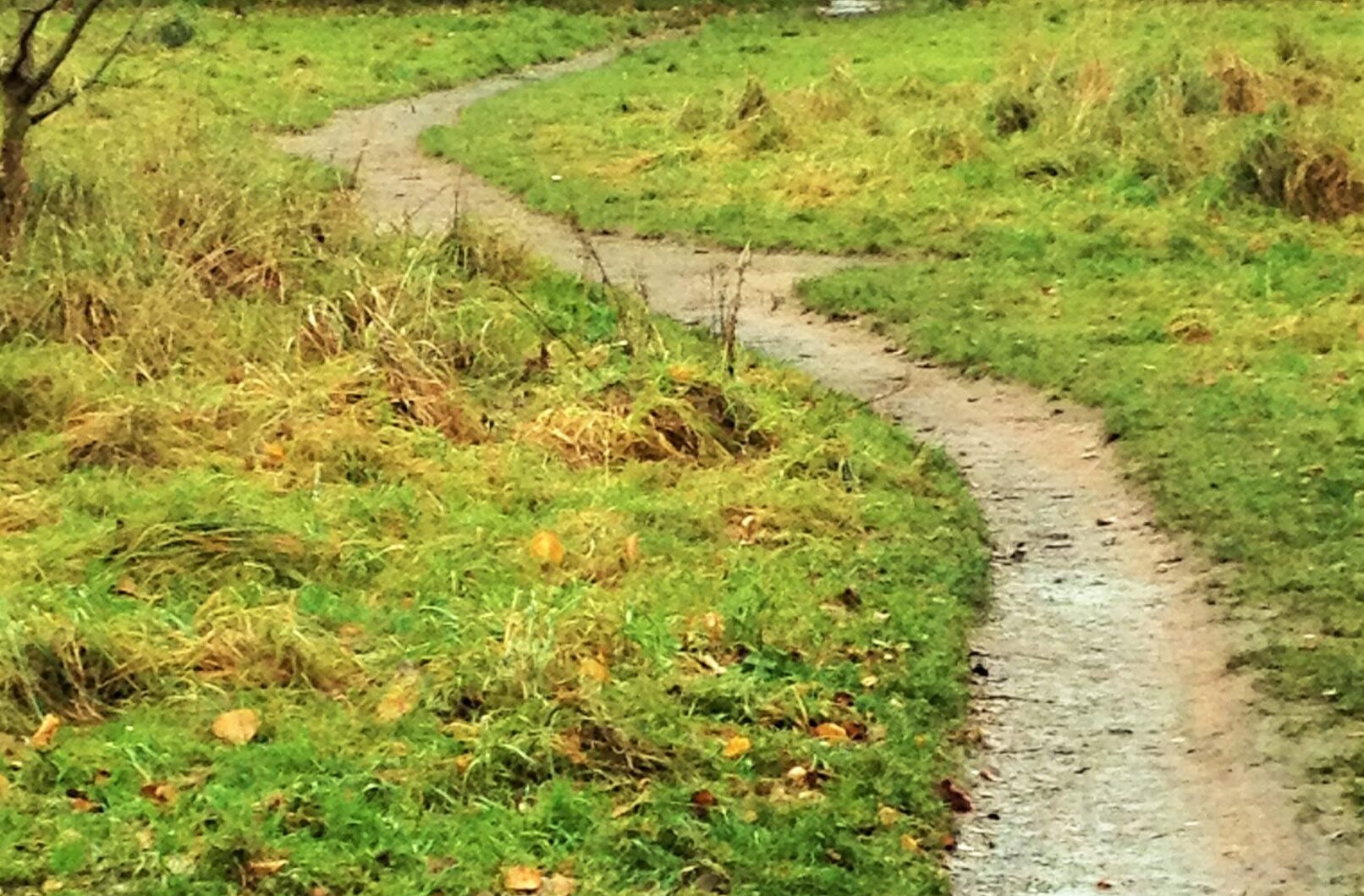
The visual image I use for that session is a photo of a piece of grass near my house on which is a well tramped but entirely unofficial path, as shown here. 
The pathway has been created by many many feet tramping in the same direction for days, months, years. It is the default way across the grass, requiring no thought or effort. Our feet simply follow the established path.
So too with our thought processes.
Our brains are designed to conserve energy, and so will follow well established thought patterns because they require no extra thinking effort. When this comes to negative self talk, we find ourselves all-too-easily on that same familiar pathway, telling ourselves the same things over and over again.
We become what we think.
This can have devastating consequences – repeat to yourself often enough that you are a failure or not worth anything or not as capable as […person of choice…] and that belief system will underpin and undermine everything you do.
To change our thought processes takes time, repetition, practice and reinforcement of our new thinking patterns. Just as creating a new path across the grass would take multiple times of walking the same way to trample down the fresh grass, so creating new patterns of thinking in our heads takes repeating our new belief so that it becomes the default.
I know this. I teach this. However…
…it turns out that putting this into practice is the sticking point when it comes to learning to slow.
I know that stopping, being still and quiet, and resetting during the day are important.
But I am having to unlearn long established patterns of busyness and get-on-with-the-next-thing-ness.
The One Degree Principle is a great reminder to give ourselves grace for change, but also to keep change small and achievable. I doubt Van Gogh referred to it as the One Degree Principle, but he was spot on. Read what I am talking about here if that has mystified you.
Where are you getting stuck?
What are you trying to change, what new habits are you trying to build? Where are the sticking points for you?
This week, give yourself grace to recognise that change takes practice, repetition and reinforcement. Let your mind and soul have some space to acknowledge what you are unlearning, even as you are trying to learn something new.
Slowing takes time. New habits take time.
Notice and celebrate small wins.
Don’t beat yourself up for where you believe things have not gone as you planned.
Recommit to the change you want to make – be it a new habit, or stopping to notice and be still for a few minutes a day – and why that change is important.
And take a minute to reflect on how you will be different when that change is well established as your default pattern.